
Muhammad Najash
- SEO
- May 2, 2026
How to Write SEO Content That Ranks in 2026: A Beginner's Complete Guide
Table of Contents
1. What Is SEO Content Writing?
2.Why SEO Content Matters More Than Ever in 2026
3. How to Find the Right Keyword Before You Write
4. How to Structure Your Content for SEO
5How to Write SEO Content Step by Step
6. What Is E-E-A-T and Why It Determines Your Rankings
7. How to Write for AI Overviews and AI Search Tools
8. Common SEO Content Mistakes Beginners Make
9. Best Tools for SEO Content Writing in 2026
10. Conclusion
Here is something most SEO guides still get wrong: ranking on search engines in 2026 is not primarily about keywords and backlinks.
Search has fundamentally changed. Search engines now answer questions directly at the top of results through AI-powered features. Platforms like ChatGPT and Perplexity pull from published web content to generate their answers. Your content now needs to do two things at once: rank in traditional search results and get cited by AI search tools as a trusted source.
The good news? The core skill that makes both happen is the same. Writing SEO content that genuinely helps your reader is the foundation of everything. This guide gives you a step-by-step process built for how search actually works today.
Whether you are a local business owner, a freelancer, or someone starting their first blog, this guide will show you exactly what to do and why it works.
What Is SEO Content Writing?
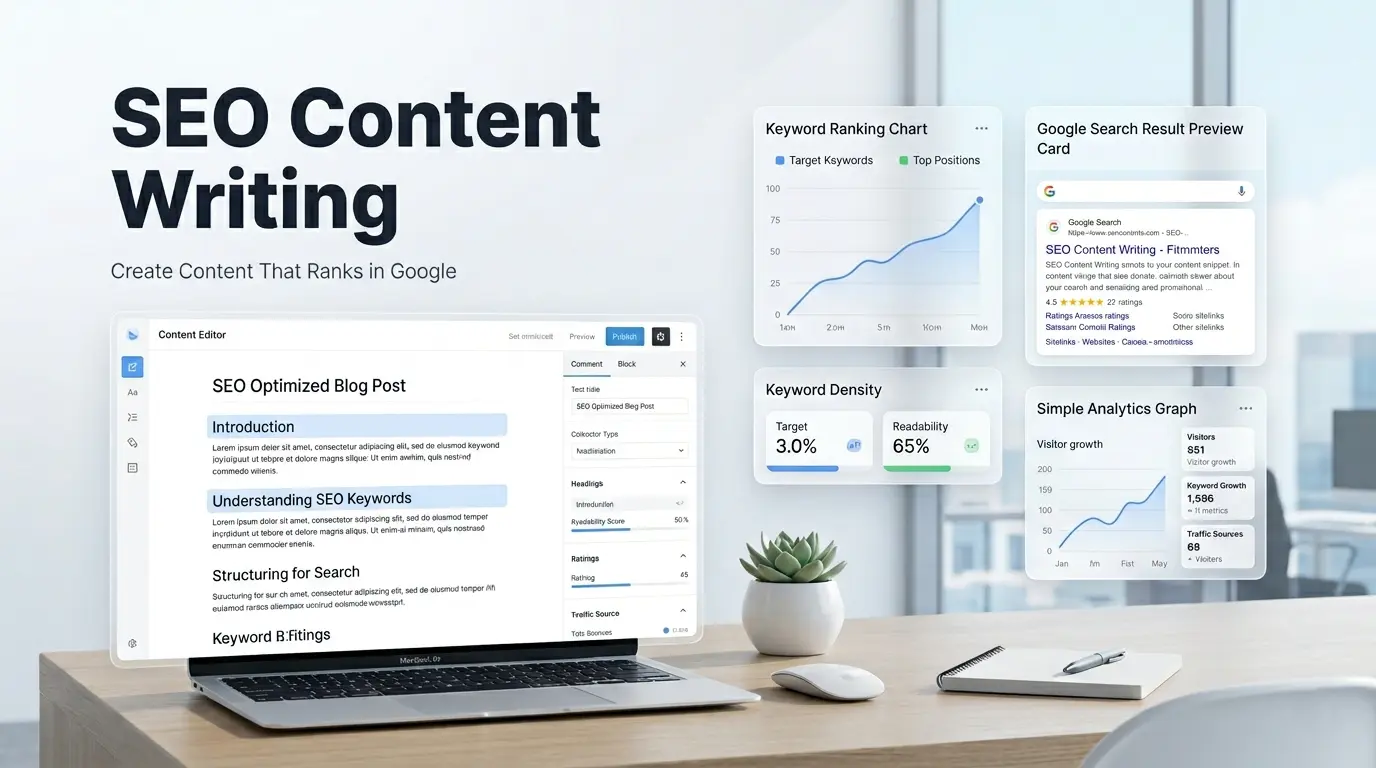
SEO content writing means creating content that answers a specific question your audience is searching for. It must be structured clearly enough that search engines rank it and AI search tools cite it as a reliable source.
The definition has expanded significantly in recent years. It used to mean publishing a good blog post with the right keywords. Today it means producing content that serves both a human reader and an AI system. Content worth recommending.
Search engine quality guidelines describe this as “people-first content”. Your primary job is serving the reader. But the way you structure and present that helpful information determines whether search engines or AI search tools surface it at all.
Think of it this way: you are not just writing an article. You are creating an answer that deserves to rank at the top. Whether someone searches on Google, Bing, ChatGPT, Perplexity, or any AI search tool pulling from the web, your content should be the one they find. That is the modern standard.
Why SEO Content Matters More Than Ever in 2026
SEO content is now the most cost-effective way to get visible online because it works in both traditional search results and AI-generated summaries.
Google processes over 14 billion searches every day. AI Overviews appear in roughly 10 to 12% of all queries, mostly informational and how-to searches, which is exactly where blog content lives. Being cited inside AI search tools and AI Overviews gives your brand visibility even when a user does not click through to your site.
At the same time, Google’s 2026 core updates introduced a quality signal called information gain. This measures how much genuinely new, original knowledge your content adds compared to competing pages. Content that simply rewrites what competitors already published ranks less confidently than it once did.
For local businesses, this creates a real opportunity. Most small business websites have no original content at all. Publishing three to five well-researched, experience-driven articles gives you an immediate advantage over competitors still relying solely on their Google Business Profile.
How to Find the Right Keyword Before You Write
Choosing the right keyword before you write a single sentence is the step that determines whether your content will ever be found.
Your keyword is the specific phrase your ideal customer types into a search engine. Every piece of SEO content needs one primary keyword and that keyword shapes your title, headings, URL, and the entire focus of the article.
How to Choose a Keyword That You Can Actually Rank For
Start by thinking like your customer. What exact phrase would they type when they need your help? A plumber’s customer might search “why is my water pressure low.” A content writer’s client might search “how to write SEO content” or “why is my blog not getting traffic.”
Use these free tools to validate your keyword:
- Search engine autocomplete. Type your keyword and read the suggestions. Each one is a real phrase people are searching.
- People Also Ask box. Scroll into the search results for your keyword. These questions are the strongest signal of what subtopics belong in your article.
- Google Search Console. If your site is already live, this shows the exact keywords bringing people to you right now.
- Ubersuggest (free tier). Shows monthly search volume and a basic difficulty score.
Target specific, longer phrases when your site is new. “How to write SEO content for local businesses” is far easier to rank for than “SEO content.” Longer phrases attract readers who are closer to taking action.
One more thing to watch for: keyword cannibalization. If you already have a page targeting “SEO content tips,” publishing another article on “how to write SEO content” can split your ranking signals and hurt both pages. Check your existing content before building a new piece.
Understanding Search Intent: The Skill That Changes Everything
Search intent is the real goal behind a search query. Matching it correctly is the single most important factor in whether your content ranks. It matters more than keyword density, word count, or backlinks.
Search engines categorise intent into four types:
- Informational. The person wants to learn. (“how to write SEO content”)
- Navigational. The person wants a specific website. (“Ahrefs login”)
- Commercial. The person is comparing options. (“best SEO tools for small business”)
- Transactional. The person wants to buy or act. (“hire SEO content writer”)
If someone searches “how to write SEO content,” they want a practical guide, not a services page. Match the intent precisely and search engines reward you. Miss it, and even perfect keyword placement will not save your rankings.
A quick way to confirm intent: search your keyword and look at the top three results. If they are all tutorials, write a tutorial. If they are all listicles, consider that format. Search engines are showing you exactly what works.
How to Structure Your Content for SEO
Structure is what separates content that gets read from content that gets skimmed and abandoned. Before you write a single sentence, you need to know your content’s shape.
Build your heading hierarchy first
Map out your H1, H2s, and H3s before you open a blank document. Your H1 is the page title. Include your primary keyword near the start. Each H2 covers one major section of the topic. H3s break down complex sections inside each H2.
This structure does three things: it keeps your writing focused, it helps readers navigate, and it signals to search engines exactly what each section covers.
Include your primary keyword or a close variation in at least two H2 headings. Do not force it. If it reads unnaturally, use a related phrase instead.
How long should your SEO content be?
Content length should match what the topic requires, not a word count target. That said, beginners need practical benchmarks to start.
For informational and how-to content, aim for 1,500 to 2,500 words for competitive keywords. For less competitive or very specific topics, 800 to 1,200 words can rank well if the content is genuinely complete.
Here is a better way to think about it: search your keyword and check the average word count of the top three results. Your content should be at least as thorough, ideally more so.
What search engines penalise is content that pads for length. Filler phrases, repetitive sentences, and obvious word-count chasing are negative signals. Depth plus originality is the 2026 standard, not volume.
How to Write SEO Content Step by Step
Writing SEO content follows a clear, repeatable process. Master these steps and every piece you publish will be stronger than the last.
Step 1: Pick One Primary Keyword and Confirm the Intent
Choose one specific keyword. Verify the monthly search volume is worth your time (anything above 100 searches per month is worth targeting for a new site). Confirm the intent matches what you plan to write. Do not move forward until both boxes are checked.
Step 2: Research the Top Three Competing Pages
Search your keyword and read the top three results thoroughly. Take notes on what they cover and, more importantly, what questions they skip. Your content must cover everything the top results do, plus answer the gaps they leave open.
Those gaps are your content differentiation opportunity. Search engine algorithms reward content that adds something genuinely new to the conversation. Find what competitors missed and cover it clearly.
Step 3: Write your title tag and meta description to earn clicks
Your title tag appears in search results and must include your primary keyword near the start. Keep it under 60 characters. Your meta description appears below the title. Make it 150 to 160 characters, include the keyword in the first half, and make a specific promise to the reader.
Title examples:
Weak: “SEO Tips for Writers”
Strong: “How to Write SEO Content That Ranks in 2026”
Meta description examples:
Weak: “Learn about SEO content writing in this guide.”
Strong: “Learn how to write SEO content step by step in 2026. Keyword research, structure, real examples, and a pre-publish checklist included.”
Step 4: Hook your reader in the first 100 words
Your opening sentence must stop a skimmer from scrolling away. Use a bold statement, a surprising fact, or a direct question that immediately establishes relevance. Never open with “In this article” or “Today we will discuss”.
Include your primary keyword naturally within the first 100 words. Do not force it. Weave it in where it fits.
Step 5: Write body content using the answer-first method
Open every section with the most direct answer to what that section promises. Then explain the reasoning, provide an example, and move forward. This structure reduces bounce rate because readers get value immediately instead of hunting for it.
Keep paragraphs to three sentences maximum. Use numbered lists for processes, bullet points for options, and bold text for your most important terms.
Short, specific sentences always outperform long ones. If a sentence needs a second comma, it probably needs to become two sentences.
Step 6: Add internal links with descriptive anchor text
Link to other relevant pages on your site where it fits naturally. Use anchor text that describes the linked page clearly.
- Weak anchor text: “click here”
- Strong anchor text: “on-page SEO checklist for beginners”
Internal links build topical authority. This is the signal that tells search engines your site covers a subject in depth, not just superficially. A site with ten well-linked articles about SEO will outrank a site with one article in isolation.
Step 7: Optimise images with alt text
Every image needs alt text, which is a short, descriptive phrase explaining what the image shows. Include your primary keyword naturally in at least one image’s alt text. Alt text helps visually impaired readers and gives search engines an additional content signal.
File naming matters too. “seo-content-writing-guide.jpg” is a stronger signal than “image-001.jpg.”
Step 8: Write a conclusion with a specific call to action
Summarise your single most important takeaway. Mention your primary keyword naturally. End with a specific, descriptive CTA that tells the reader exactly what to do next.
- Weak CTA: “Contact us today.”
- Strong CTA: “Ready to get your first blog post ranking? Book a free content strategy call with Muhammad Najash and walk away with a keyword plan built around your business.”
What Is E-E-A-T and Why It Determines Your Rankings
E-E-A-T stands for Experience, Expertise, Authoritativeness, and Trustworthiness. It is the framework search engine quality systems use to evaluate whether content deserves to rank. In 2026, with AI-generated content flooding search results, these systems are specifically designed to detect whether content comes from someone with real, lived experience.
Understanding E-E-A-T is what separates beginners who wonder why their technically correct content fails to rank from writers who consistently earn top positions.
What each letter means in practice
Experience. Has the author actually done the thing they are writing about? Search engines and AI systems now explicitly check for first-hand experience. A plumber writing about plumbing outranks a marketing generalist writing about plumbing. Include your own tested processes, specific examples from your work, and results you have personally observed.
Expertise. Does the author have the knowledge to be a credible source? For beginners, expertise is demonstrated through depth and accuracy, not credentials. A thorough, well-researched, error-free article signals expertise more than a name with a title.
Authoritativeness. Is the site recognised as a reliable source in its niche? This is built over time through consistent publishing, mentions from other credible sites, and a cohesive topical focus. Writing five deeply useful articles on one subject builds more authority than writing one article on every topic under the sun.
Trustworthiness. Can readers verify who wrote this and why? Add a clear author bio with your credentials and relevant experience. Link to your social profiles or portfolio. Use HTTPS. Cite sources where appropriate.
How to demonstrate E-E-A-T in your content
- Include a specific author bio at the bottom of every post. Add your name, credentials, and a link to your work.
- Add real data, case studies, and examples from your own experience.
- Reference other credible sources naturally. This signals research depth.
- Keep your content accurate and update it when information changes.
- Use structured data (Article schema or BlogPosting schema) to help search engines and AI tools verify author and publication information.
How to Write for AI Overviews and AI Search Tools
AI Overviews and AI search tools like ChatGPT and Perplexity now appear at the very top of results for informational queries. They pull the clearest, most direct answers from multiple web sources and cite those sources. Getting cited inside AI search tools means your brand appears before the first traditional organic result.
Optimising for AI citation is called Generative Engine Optimization (GEO). Here is what it means for your content.
Lead Every Section with a Direct Answer Sentence
AI search tools extract the clearest, most direct statements from content. If the answer to a question is buried in paragraph three, AI will not find it. Put the most important answer in the first sentence of each section. It should be one clear, complete sentence that could stand alone as a response.
Buried answer (weak): “There are many factors that go into keyword research. You need to think about your audience, your competition, and your budget. Once you’ve considered all that, you should look at search volume…”
Answer-first (strong): “Keyword research means finding the specific phrases your ideal customer types into search engines and choosing the ones you have a realistic chance of ranking for.”
Format Content in Extractable Blocks
Use numbered steps, labelled bullet points, and clear definitions. AI search tools prefer content that is modular. Each section should be able to be lifted and cited independently without losing meaning. Think of each H2 section as a self-contained answer unit.
Add a Key Takeaways section at the top
A five-bullet summary at the top of your post signals to AI search tools that your page is structured for fast extraction. Busy readers and AI systems both respond to this format. It is the single easiest structural change that improves GEO performance.
Add original insight that AI systems cannot replicate
Search engines and AI tools reward content that adds something no competitor has said. Include your own tested experience, real client results, specific numbers, and genuine opinions. AI search tools prioritise citing sources with original perspectives because they make summaries more useful and accurate.
Common SEO Content Mistakes Beginners Make
Most beginners do not lose rankings because they lack knowledge. They lose because they repeat the same avoidable mistakes.
Mistake 1: Writing for the Algorithm Instead of the Reader
Stuffing keywords, adding filler paragraphs to hit a word count, or copying what competitors already said are tactics that do not work in 2026. Search engine quality systems detect content that exists to rank rather than to help. Write every sentence as if the reader is a real person who sought out your expertise.
Mistake 2: Ignoring Search Intent Completely
A perfectly written article will not rank if its format does not match what the searcher expects. If every top result for your keyword is a step-by-step guide and you publish a glossy overview piece, you will underperform. Not because your content is worse, but because it does not match the established intent pattern search engines have learned for that keyword.
Mistake 3: Publishing thin content with no original insight
A 400-word post that repeats surface-level advice cannot compete with a well-researched, experience-driven article. But length alone is not the answer. The 2026 standard is depth plus originality. Cover the topic completely and add something no competing page has said.
Mistake 4: Publishing without running a technical checklist
Many beginners produce strong content then sabotage it with preventable technical errors. Before publishing any article, run through this checklist:
- Primary keyword in the H1 title
- Primary keyword within the first 100 words
- Title tag under 60 characters with keyword near the start
- Meta description 150 to 160 characters with keyword in the first half
- URL slug is descriptive (e.g., /how-to-write-seo-content/ not /?p=1284)
- At least one image with keyword in alt text
- At least two internal links with descriptive anchor text
- Article schema or BlogPosting structured data added
- Page loads in under 3 seconds on mobile (check with Google PageSpeed Insights)
- Author bio with credentials is visible on the page
Mistake 5: Never updating your published content
SEO content is not a “write once and forget” strategy. Content freshness is a ranking signal. Search engines favour recently updated pages for informational queries. Content that ranked well twelve months ago can quietly slip to page two as competitors publish fresher alternatives.
Schedule a content review every four to six months for every major post. Use Google Search Console to see which queries your post ranks for, then expand the sections that match those queries. Add new examples, update statistics, and answer questions that appear in the People Also Ask box for your keyword. This process is called a content refresh and it is often faster than publishing a new article from scratch.
Best Tools for SEO Content Writing in 2026
You do not need to spend money to write content that ranks. These tools cover everything a beginner needs.
Google Search Console (free): The single most important tool available. Connect your site here before anything else. It shows which keywords bring people to your site, which pages earn clicks, and where you are losing rankings.
People Also Ask and AI Overviews (free, built into search engines): Search your keyword and study every People Also Ask question. These are the exact sub-topics your content should answer. Check whether an AI Overview or AI search result appears for your keyword. That tells you whether AI citation is possible for that query.
Ubersuggest (free tier): A solid starting point for keyword research. Shows monthly search volume and basic keyword difficulty for any phrase.
Semrush (free account): Gives ten free keyword lookups per day and shows what your competitors rank for. The free tier is enough to build a keyword strategy for a new site.
ChatGPT or Google Gemini (free): Use AI assistants for brainstorming, finding related questions, and drafting content outlines. Never publish AI output as final content. Use it as a starting point and rewrite everything with your own experience and voice.
Yoast SEO or Rank Math (free WordPress plugins) : Real-time feedback on keyword placement, readability, meta description length, and internal linking as you write. Essential for WordPress users.
Hemingway Editor (free, web-based): Paste your draft in and it highlights sentences that are too long, passive voice constructions, and unnecessary adverbs. Target a Grade 7 to 8 readability score.
Google PageSpeed Insights (free): Tests how fast your page loads on mobile. Page speed is a confirmed ranking factor. A slow page with great content will underperform a fast page with good content.
Conclusion
Writing SEO content that ranks in 2026 comes down to one principle: answer your reader’s question better than anyone else and structure that answer so search engines and AI search tools can find, trust, and cite it.
Start with the right keyword. Match your reader’s true intent. Build a clear heading structure before you write. Lead every section with a direct answer. Add your own experience and original insight, the one thing no competitor can copy or AI can fabricate. Run the technical checklist before you publish. Then measure, refresh, and improve.
Local businesses and freelancers who apply this process consistently do not just attract traffic. They attract trust. And trust turns readers into clients.
If you want a content plan built specifically for your business, including keyword research, article briefs, and a publishing strategy tailored to your market, book a free discovery call with Muhammad Najash today.
Post author
Najash is a passionate blogger and SEO Specialist based in Kannur, Kerala, dedicated to sharing meaningful ideas and data-driven insights. With deep expertise in search engine optimization, Najash helps brands and businesses grow their online presence through smart strategies. Follow along for expert tips and practical advice that make every read worthwhile.
Related Article
- All Posts
- SEO